
It started with a problem that sounds small until you multiply it. At many pharmacies, compounds are still measured by hand. One dose, one powder, one scale at a time. It works, and it has worked for a long time. But do it thousands of times a day and it becomes a bottleneck that no amount of care can speed up.
Medrock Pharmacy knows the scale of that exactly.
“Our own companies serve over 500,000 prescriptions a year, and to do all of these by hand, it's very tedious. It takes a lot of manpower, and the accuracy is something that we would like to have a little bit higher.”
So Medrock and MedDots AI asked a different question: what if we could automate it? And then they made an unusual decision. Instead of building the solution themselves, or hiring a firm to do it, they put the problem in front of high school students.
A competition with a budget attached
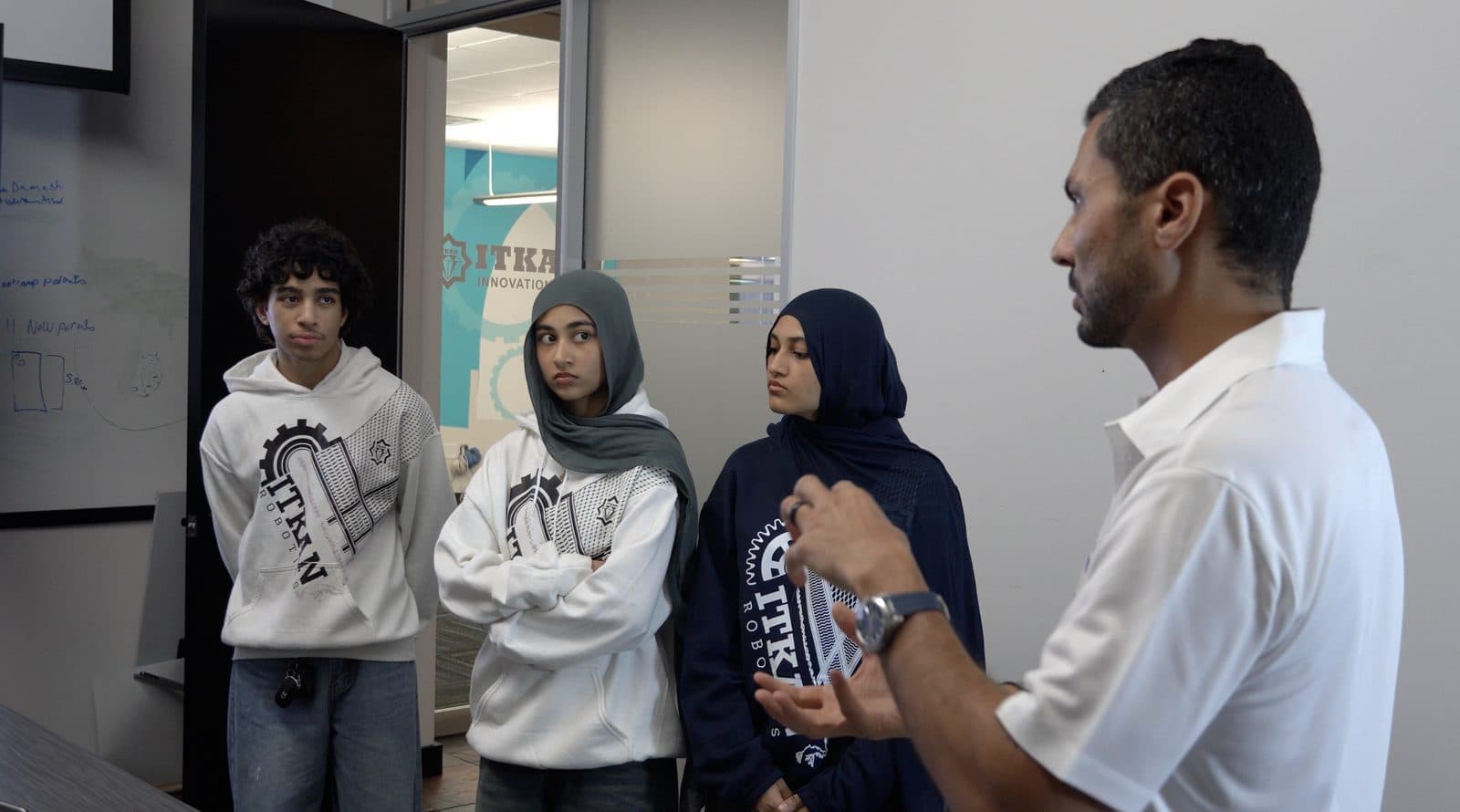
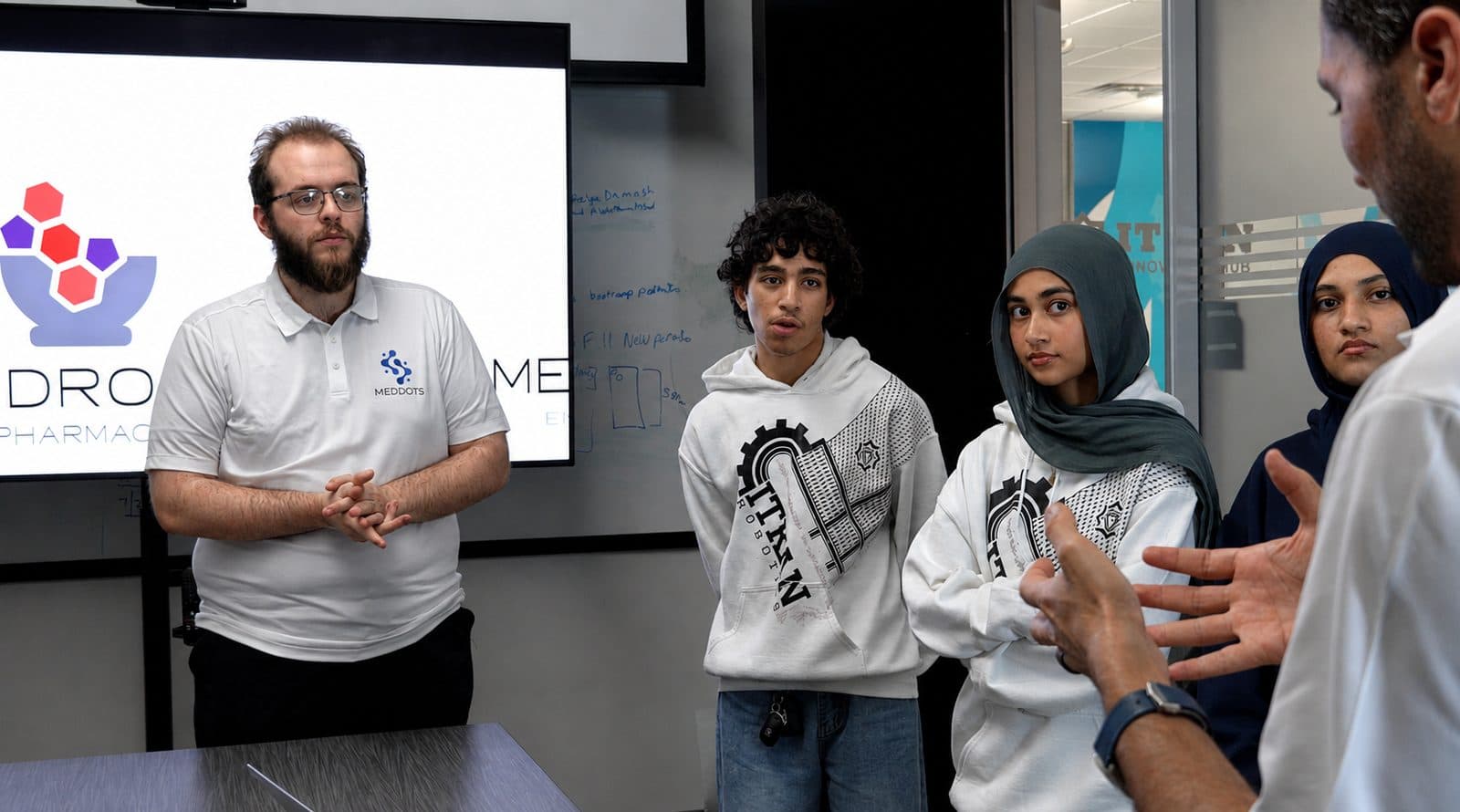
This summer ITKAN formed a partnership with FIRST in Texas and Medrock Pharmacy, and announced a program in which teams from across the state competed over three months for the best design to automate compound mixing. Five teams took on the same brief, three of them ITKAN's, and each had to find its own way through it.
The structure is the part that made it feel less like a class and more like a contract. The competition ran in phases, each with a deadline and a defined goal, and the money followed the work.
“Each team was given an initial budget, and every time they meet the phase goal, additional funds were provided.”
The brief itself was not a simplified classroom version. The students were asked to automate both the dispensing of pharmaceutical powders and the weighing of them, to a tolerance the industry would actually accept.
“The essential problem that we're solving is to automate powder dispensing, but also the weighing portion of it. When you try to weigh powders that are so delicate, and especially powders that can cost up to $30,000 per milligram, it gets very sophisticated. Am I measuring this powder correctly? How much am I dispensing? And am I doing this fast enough that I can measure this for hundreds of other powders?”
Every two weeks the teams were validated live against criteria set by MedDots, and graded on the result. The design of that review is worth noticing, because it was built to defeat the usual student instinct.
“A lot of times we'll give them the minimum, maximum ranges that they could be tested against, and then on the milestone day we give them the actual powder as well as the actual ranges they have to test against. This is so that they build their machines to actually meet the criteria we're looking to solve, instead of building the machines to specifically pass a milestone.”
Where it got hard
Pretty quickly it stopped being about building a machine and started being about making one work. The teams tested, reworked, ran into things that failed, and kept going. Accuracy was the wall most of them hit, and the fix was not the one the students expected.

“The milestone that gave us the most amount of difficulty was probably milestone three, due to the accuracy levels. But we really overcame that more with our mechanical than our software. We made sure to have extra initiatives in order to stop the powder from overshooting, so often we would actually shoot under the target in order to make sure that we're still within that accuracy.”
Deliberately undershooting a target to stay inside a tolerance is not something anyone teaches in a robotics class. It is the kind of judgement that only shows up when a real specification refuses to bend.
By the end, what had started as a single doser had become a system capable of handling multiple ingredients and compounding them autonomously.
Why this was different
Our students compete year-round, and they are used to hard engineering. This was not that. There was a real client, a real working environment, and a problem that did not have a known answer at the back of the book.
“I think it's really cool that as high school students we're getting to solve an industry-level problem. I've never had that opportunity to actually come across a problem that many experts are trying to solve, and we're actually actively trying to solve it. I think that's an amazing experience, and I love it.”
The machine was the deliverable. What the students carried out of those three months was the rest of it: how to work with a client, how to take feedback that costs you a design you liked, how to learn from a failure with a deadline attached, and how to turn an idea into something that holds up outside the room it was built in.
For the partners, the return ran in both directions.
“You don't just get fresh eyes on your complex problem. You get to be involved with your community, you get to introduce the next generation of engineers to some of the problems that you're encountering today, so that they can solve some of the problems that they're going to encounter tomorrow.”
Ashraf Ahmed put the same thought from the other side, as the person who decided to hand the problem over in the first place.
“The teams that we have here are very, very smart and unique teams. The way that they think about solving the problems, the way that they do the designs, and the way that they code, all of these are different approaches than what we saw from the big companies.”
The reason we do this
Writing about the program afterwards, ITKAN President Dr. Mohamed Ebeida put the point more bluntly than any of it.
“This is why we do robotics. Our world class students compete in international competitions and win, not for the trophies and a few bullets on their resume. We established this amazing system and invested a lot to train our students on solving real problems for different industries.”
His verdict on the results was that our high schoolers wowed the experts with the innovative solutions they came up with. His verdict on what it says about everything around them was less comfortable.
“The world is really changing, and with AI and proper training, high schoolers can start their professional life before even going to college. Our current educational system is completely failing on this front. Community programs like ITKAN are critical to fill this gap.”
Three months ago this was a problem on a pharmacy floor. It is now a working solution, built by student teams who have the experience to take what they learned and build something bigger.

Our thanks to Medrock Pharmacy, MedDots AI and FIRST for trusting our students with a real problem, to Christopher Moore and Eric van Gemeren, and to the City of Plano and Mayor John Muns, council member Bob Kehr, and the City of Richardson and Mayor Amir Omar for backing the work.